LIGAND DATA
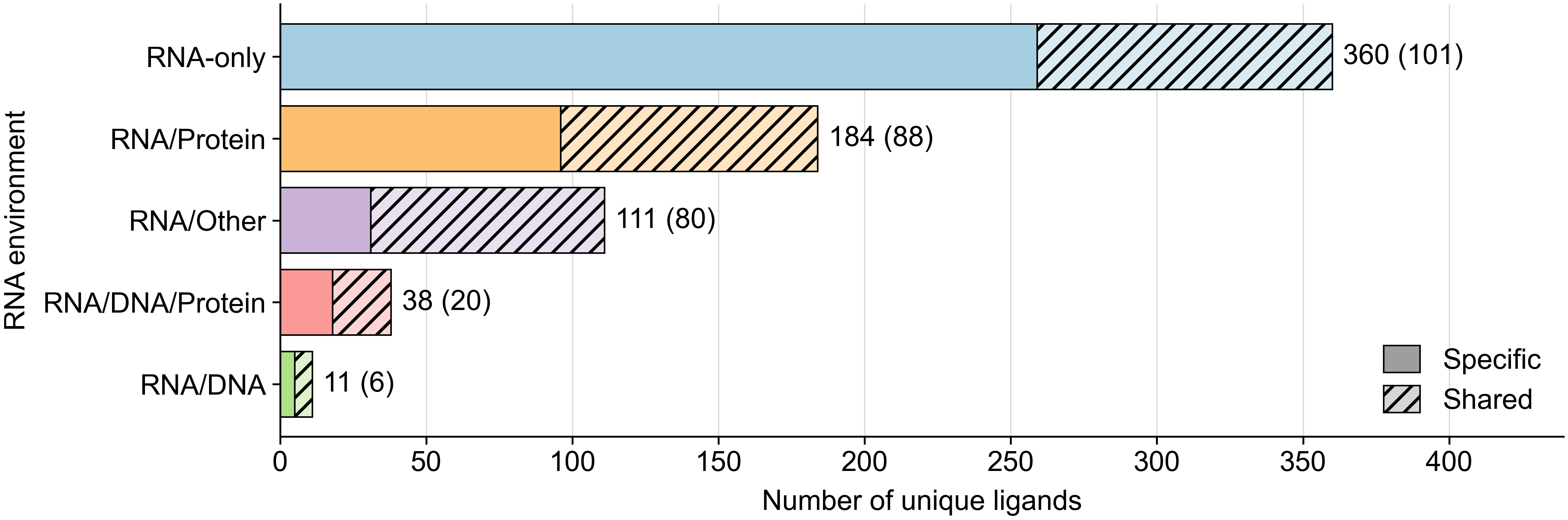
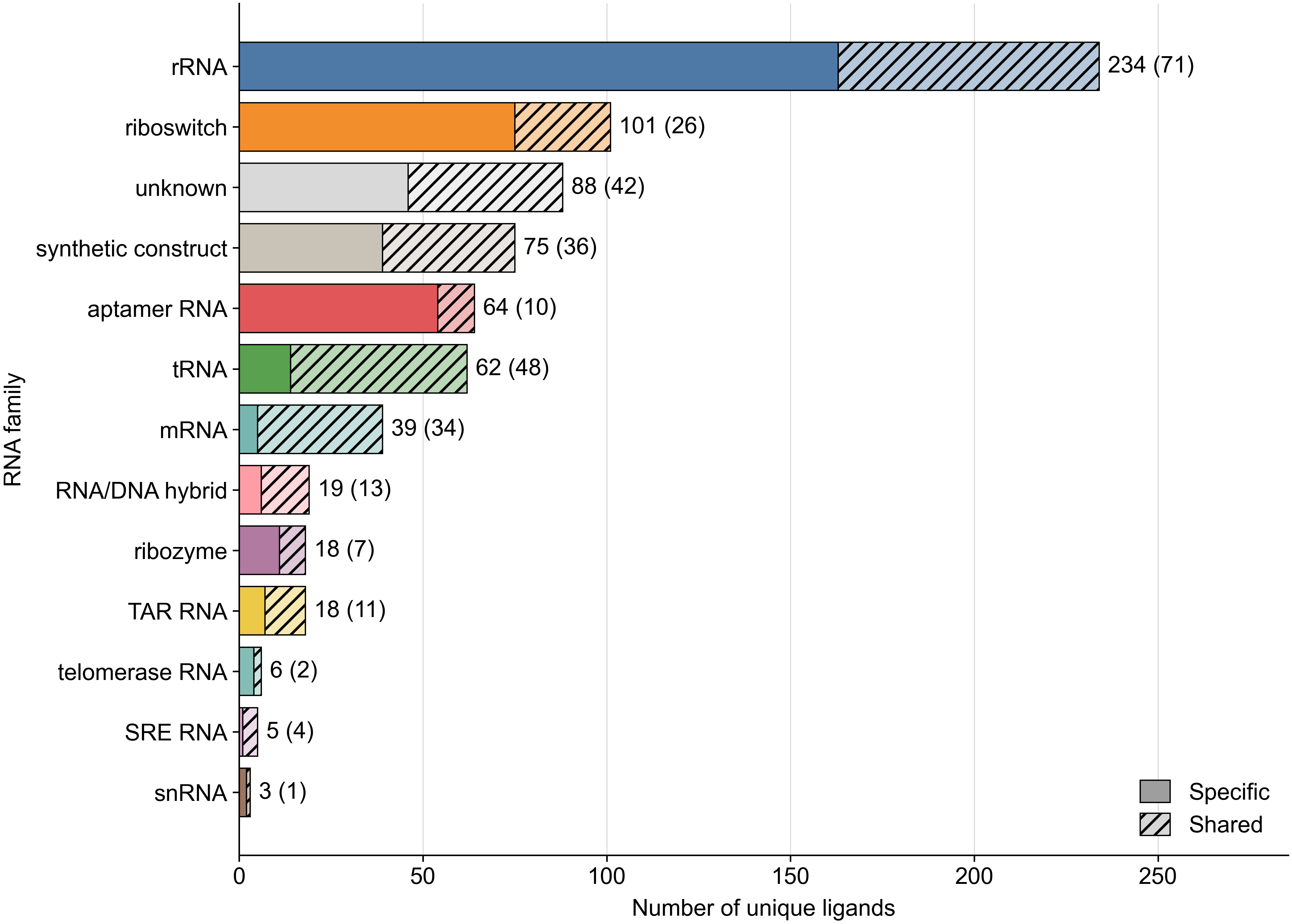
This section presents the ligand data available in HARIBOSS, with a particular focus on ligand selectivity toward their RNA targets. For each RNA family, the number of associated ligands is reported and categorized into specific binders, which are observed in a single RNA family, and shared binders, which are found across multiple families. The same specificity analysis is also provided for different molecular environments. An interactive TMAP complements these statistics by mapping the chemical space of all ligands, colored by RNA family, enabling the exploration of chemically related compounds as well as family-specific chemical clusters.
Interactive TMAP by RNA family
Tip: click inside the TMAP, then use Ctrl + mouse wheel to zoom and pan.
Searching by SMILES
You can search for compounds using their Canonical SMILES notation directly from the compounds page search bar. The search performs a case-insensitive substring match on the SMILES strings.
Examples:
CCO- Find ethanol and compounds containing this patternc1ccccc1- Find benzene and aromatic compoundsCC(=O)O- Find carboxylic acid derivatives
SMILES notation basics:
- Atoms are represented by their chemical symbols (C, N, O, etc.)
- Lowercase letters indicate aromatic atoms (c, n, o)
- Numbers indicate ring closures (c1ccccc1 = benzene ring)
- Bonds:
=(double),#(triple), single bonds are implicit - Parentheses
()indicate branching
Learn more about SMILES notation
Searching by SMARTS
You can also search for compounds using their SMARTS (SMiles ARbitrary Target Specification) notation directly from the compounds page search bar. The search performs a case-insensitive substring match on the SMARTS strings.
Examples:
[CH3][CH2][OH]- Find ethanol and compounds containing this pattern[c]1[c][c][c][c][c]1- Find aromatic rings[#6]=[#8]- Find carbonyl groups (C=O)
SMARTS notation basics:
- Atoms are represented by their chemical symbols, optionally with hydrogens (e.g.,
[CH3]) *or[*]matches any atom#6matches any carbon,#7any nitrogen, etc.- Bond symbols:
-(single),=(double),#(triple),:(aromatic) - Recursive SMARTS can describe more complex substructures